Debranch Works
Pullulanase vs Alpha Amylase and Glucoamylase | Enzyme System Guide
Compare pullulanase, alpha amylase, and glucoamylase for starch processing, brewing, distilling, and high-fermentability carbohydrate systems.
Request pricing Compare pullulanase, alpha amylase, and glucoamylase for starch processing, brewing, distilling, and high-fermentability carbohydrate systems.
Request pricingPullulanase is not a stronger version of amylase. It performs a different job.
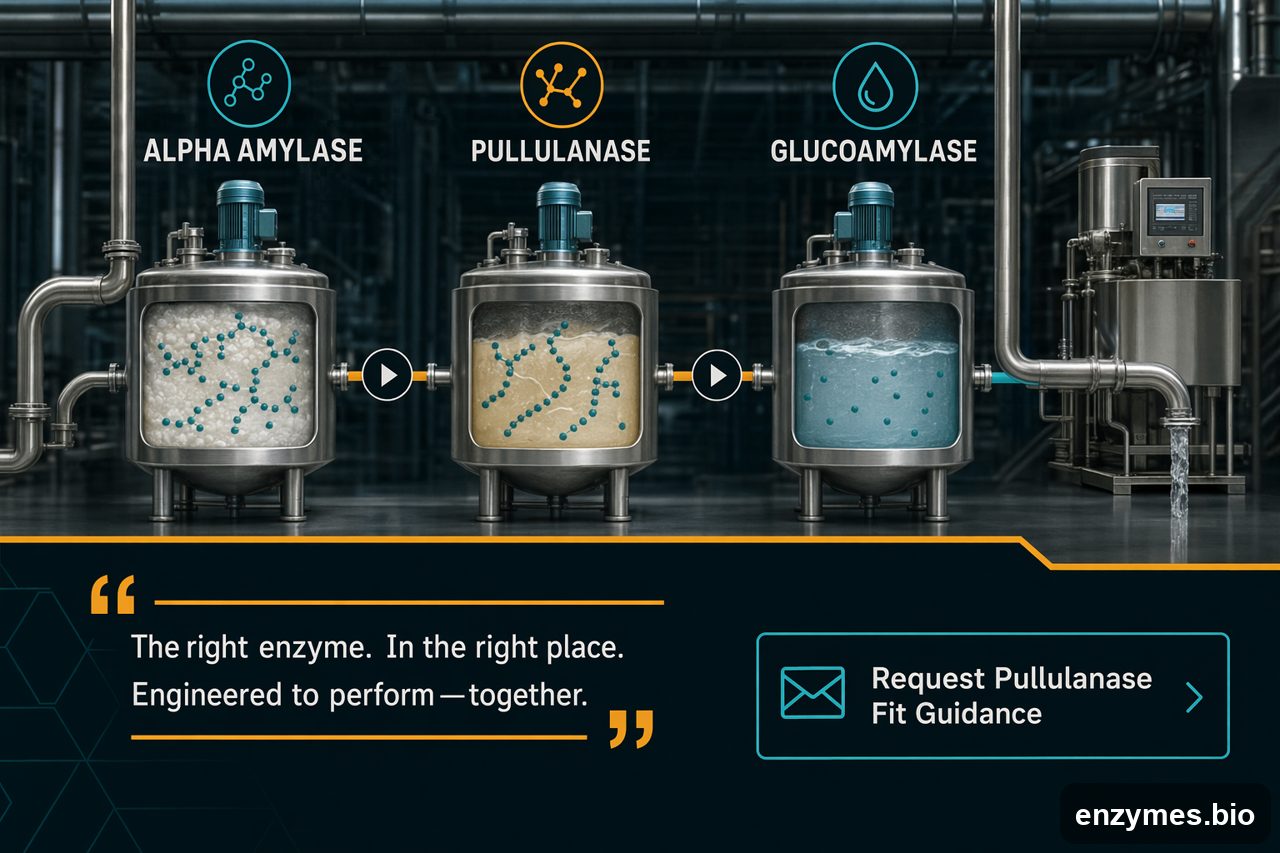
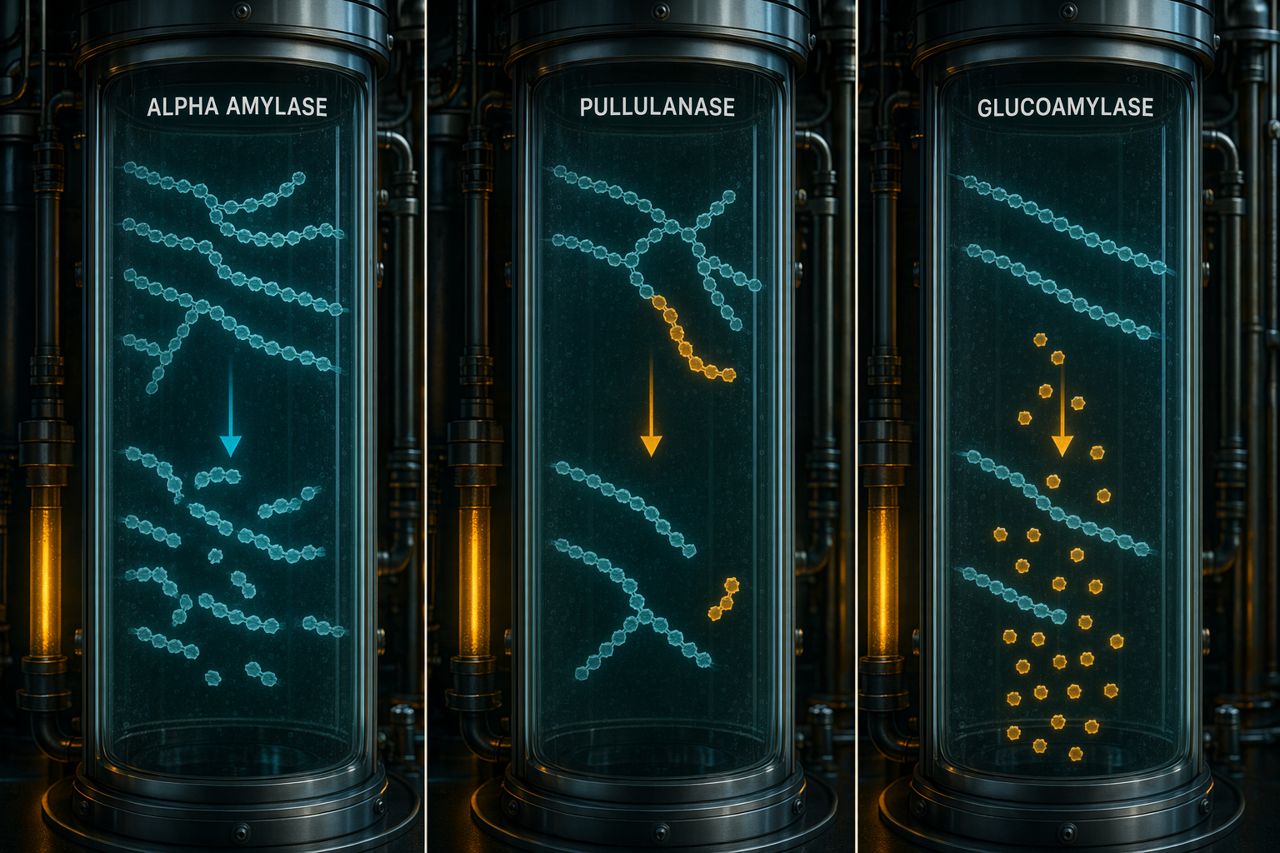
In starch conversion, alpha amylase opens the starch structure, glucoamylase releases glucose from chain ends, and pullulanase removes alpha-1,6 branch points that slow conversion. When the three are selected and timed correctly, processors can improve fermentable sugar formation, reduce residual limit dextrins, and get more value from the same starch input.
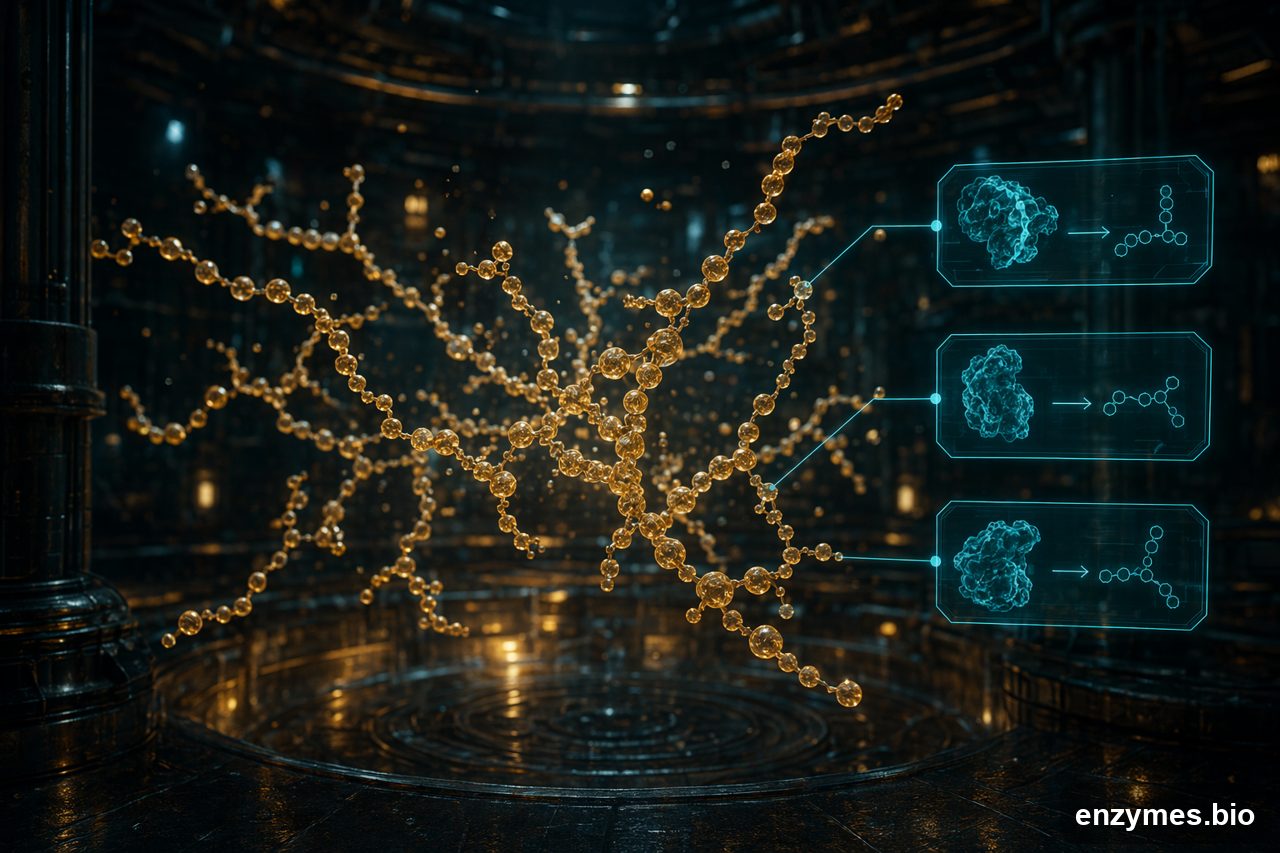
For formulation scientists, brewers, distillers, and starch processors, the key question is not which enzyme is best. The key question is where the bottleneck is: liquefaction, saccharification, debranching, fermentability, viscosity, filtration, or final carbohydrate profile.
| Enzyme | Primary bond target | Main process role | What it improves | What it does not do well alone |
|---|---|---|---|---|
| Alpha amylase | Alpha-1,4 internal starch linkages | Liquefaction and viscosity reduction | Rapid starch breakdown, pumpability, mash handling | Complete glucose release or efficient branch removal |
| Glucoamylase | Mainly alpha-1,4 chain ends; limited alpha-1,6 action | Saccharification to glucose | Dextrose formation, fermentable sugar yield | Fast debranching of highly branched dextrins |
| Pullulanase | Alpha-1,6 branch linkages | Debranching | More linear chains for glucoamylase access, lower limit dextrins, improved starch utilization | Liquefaction or broad random starch thinning |
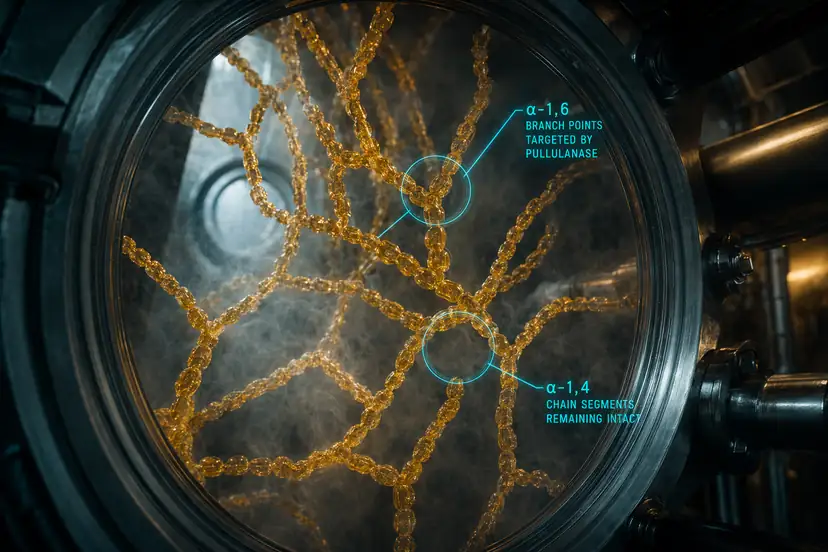
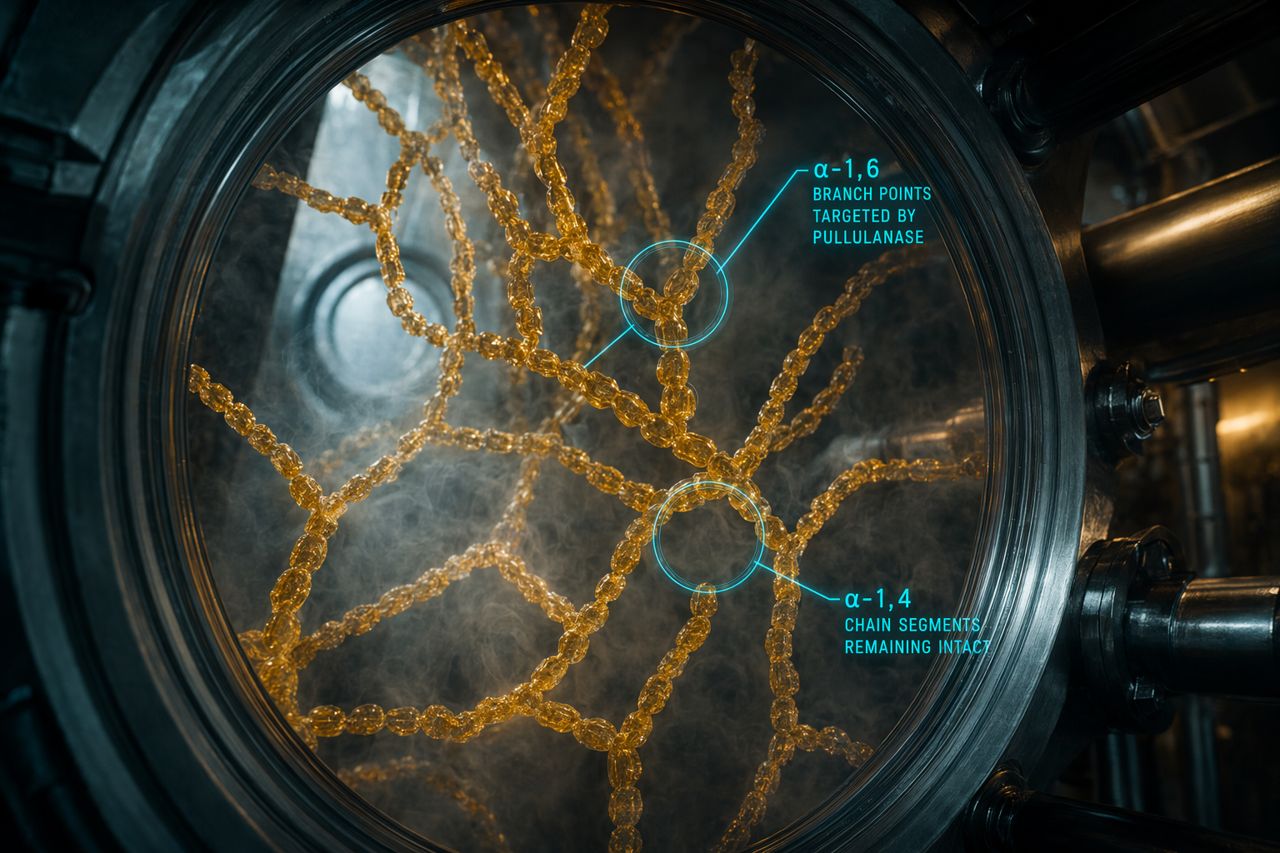
Pullulanase, formally Pullulanase (Pullulan 6-alpha-glucanohydrolase), hydrolyzes alpha-1,6 glycosidic linkages in branched glucans. In practical terms, it cuts the branch points that make amylopectin and branched dextrins difficult to finish.
That debranching action changes the geometry of the substrate. Instead of a compact, branched structure with fewer accessible ends, pullulanase creates more linear chains. Those linear chains are easier for glucoamylase and related saccharification enzymes to convert into fermentable sugars.
Pullulanase can help processors target:
Alpha amylase is typically the workhorse for liquefaction. It attacks internal alpha-1,4 linkages in gelatinized starch, rapidly reducing viscosity and creating shorter dextrins.
This is essential in starch processing because raw starch polymers are too large and viscous for efficient downstream conversion. Alpha amylase makes the slurry more processable and prepares the carbohydrate matrix for saccharification.
Alpha amylase does not selectively remove alpha-1,6 branches. It can reduce chain length, but it does not resolve the branched architecture that produces limit dextrins. In systems where residual branched dextrins are the bottleneck, adding more alpha amylase is often not the most efficient correction.
Glucoamylase works from non-reducing chain ends and releases glucose step by step. It is the central enzyme for high-glucose saccharification and many fermentation feedstock systems.
Glucoamylase can act on alpha-1,6 linkages, but that activity is typically much slower than its action on alpha-1,4 linkages. In a highly branched substrate, branch points can slow glucose release and leave behind dextrin material that is not fully utilized.
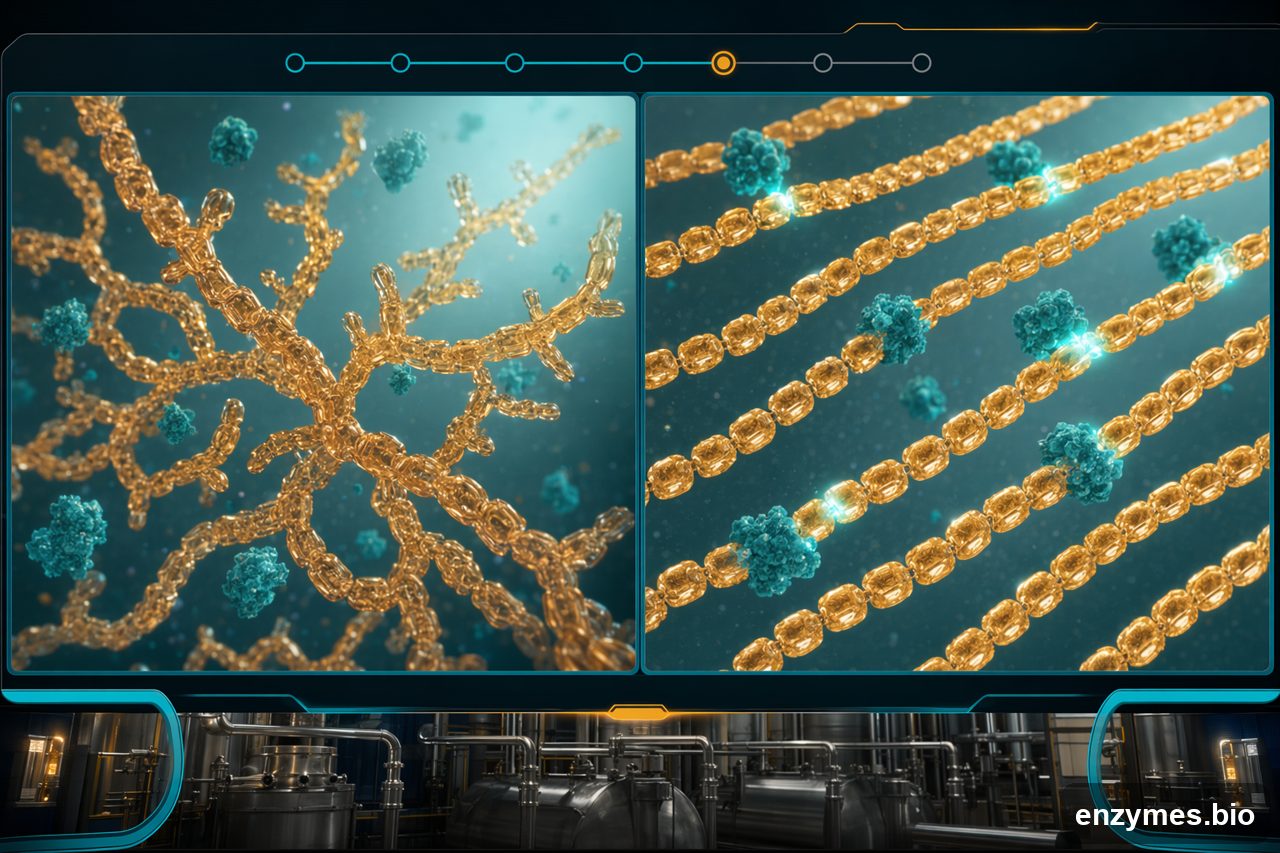
Glucoamylase performs best when it has accessible chain ends. Branch-heavy dextrins reduce that accessibility. Pullulanase complements glucoamylase by increasing the number of usable linear chain segments and removing structural obstacles.
A simple way to evaluate the three enzymes:
That difference matters because starch is not a straight-line substrate. Amylopectin is heavily branched. During conversion, those branches can become limit dextrins that resist complete saccharification. Pullulanase targets that structural problem directly.
Pullulanase is most valuable when the process already has liquefaction and saccharification activity, but the carbohydrate profile still shows evidence of branch-limited conversion.
Common signs include:
In those cases, pullulanase is not an extra enzyme for complexity. It is a targeted tool for removing the branch-point constraint.
In glucose syrup and dextrose production, pullulanase supports a more complete conversion pathway by debranching amylopectin-derived dextrins. This can improve the efficiency of glucoamylase use and help tighten the final carbohydrate profile.
For high-maltose systems, pullulanase can also support the creation of more linear substrates for beta-amylase or maltogenic activity, depending on the enzyme system design.
In brewing, fermentability is controlled by mash composition, malt enzyme contribution, adjunct type, process temperature, and conversion time. Pullulanase can help when branch dextrins limit attenuation, particularly in adjunct-heavy or high-gravity systems.
The objective is not to strip all body from the beer. The objective is controlled fermentability. Pullulanase should be selected and dosed according to target dryness, attenuation, alcohol yield, and sensory profile.
For distillers and fuel ethanol producers, pullulanase can improve starch utilization by reducing residual branched dextrins and increasing fermentable sugar availability. This can support stronger fermentation economics where starch conversion is a limiting factor.
In these systems, the commercial value is usually measured through fermentable extract, residual carbohydrate, fermentation completion, alcohol yield, and consistency across feedstock variability.
Pullulanase is also relevant where carbohydrate structure affects texture, sweetness profile, digestibility targets, or downstream processing. It can be used to reshape branched starch hydrolysates into more linear carbohydrate fractions for specific formulation outcomes.
A high-performing starch enzyme system often uses all three roles:
The best sequence depends on the substrate, thermal profile, pH window, residence time, and desired sugar spectrum. Pullulanase may be added during saccharification, after liquefaction, or in a designed overlap with other enzymes when compatibility supports it.
When comparing pullulanase options, evaluate the commercial fit rather than only the label name.
Key questions:
| Process problem | Most likely enzyme lever | Why |
|---|---|---|
| Slurry is too viscous after starch cook | Alpha amylase | Liquefaction and viscosity reduction are the priority |
| Dextrins are present but glucose formation is incomplete | Glucoamylase plus possible pullulanase | Chain-end conversion may be limited by branch structure |
| Fermentation leaves residual carbohydrate | Pullulanase with saccharification review | Branch dextrins may be limiting fermentability |
| High-gravity brewing needs more attenuation control | Pullulanase | Debranching can increase fermentable extract from starch-derived material |
| Additional glucoamylase gives diminishing returns | Pullulanase | The bottleneck may be alpha-1,6 branch access, not glucoamylase quantity |
| Final syrup profile is inconsistent | Enzyme system optimization | Liquefaction, debranching, and saccharification must be aligned |
Alpha amylase opens starch. Glucoamylase finishes chains into glucose. Pullulanase removes the branch points that block efficient finishing.
If your process is leaving value inside branched dextrins, pullulanase can be the difference between adequate conversion and engineered conversion.
Use the form below to request a quote, get pricing, or ask for a pullulanase recommendation for your substrate and process conditions. A Debranch Works technical contact will review the application context and respond through the site’s own inquiry system.
No. Glucoamylase releases glucose mainly from alpha-1,4 chain ends. Pullulanase targets alpha-1,6 branch points. They are often used together because debranching gives glucoamylase better access to linear chains.
Usually no. Alpha amylase is used for liquefaction and viscosity reduction. Pullulanase does not provide the same broad internal alpha-1,4 cutting function needed to make cooked starch processable.
If the substrate is branch-limited, more glucoamylase may deliver only incremental improvement. Pullulanase addresses the alpha-1,6 branch structure that slows finishing conversion.
It is commonly evaluated after liquefaction and during saccharification, but the best addition point depends on pH, temperature, residence time, substrate type, and the other enzymes in the system.
Measure the commercial outcome: fermentable sugar profile, residual dextrins, attenuation, glucose formation, alcohol yield, viscosity, filtration performance, or final syrup specification. The right metric depends on the application.
Tell us your application and volume — we reply with pricing and lead time.