
Debranch Works
Pullulanase and Alpha-1,6 Linkages Explained
A technical guide to how pullulanase targets alpha-1,6 branch points in starch, improving debranching, saccharification, fermentation performance, and starch utilization.
Request pricing A technical guide to how pullulanase targets alpha-1,6 branch points in starch, improving debranching, saccharification, fermentation performance, and starch utilization.
Request pricingPullulanase is used when starch conversion is limited by branches.
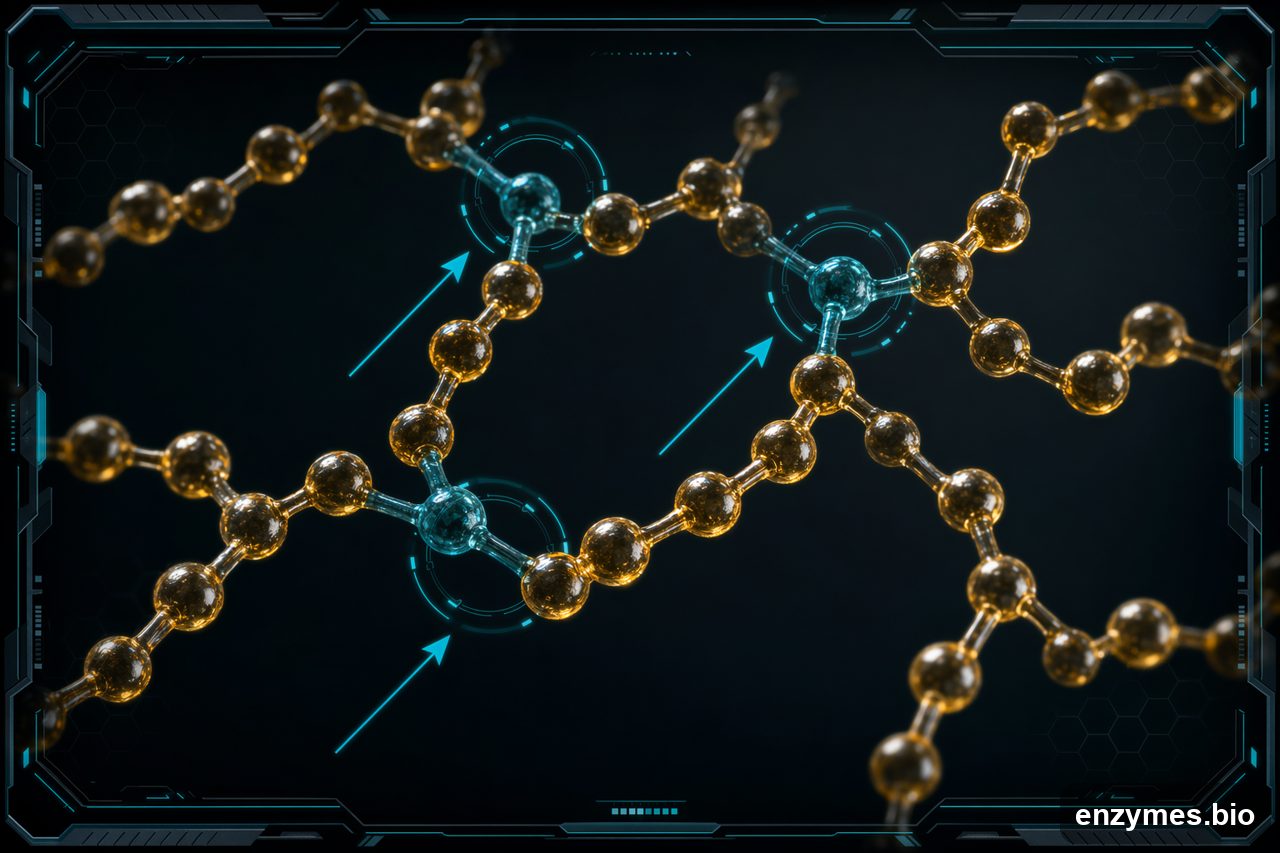
In amylopectin and branched dextrins, most glucose residues are connected by alpha-1,4 bonds. The branch points are different: they are alpha-1,6 glycosidic linkages. Those branch points slow down complete conversion, leave residual limit dextrins, and can reduce fermentable extract or dextrose yield if they are not addressed.

Pullulanase targets those alpha-1,6 linkages. That single specificity is why it matters in starch processing, brewing, distilling, and carbohydrate formulation.
An alpha-1,6 linkage is a glycosidic bond where the first carbon of one glucose unit connects to the sixth carbon of another glucose unit. In starch systems, this is the chemistry that creates branch points in amylopectin and branched dextrins.
A simplified view:
For process teams, the practical issue is not naming the bond. It is what that bond prevents: full access to starch-derived carbohydrate.
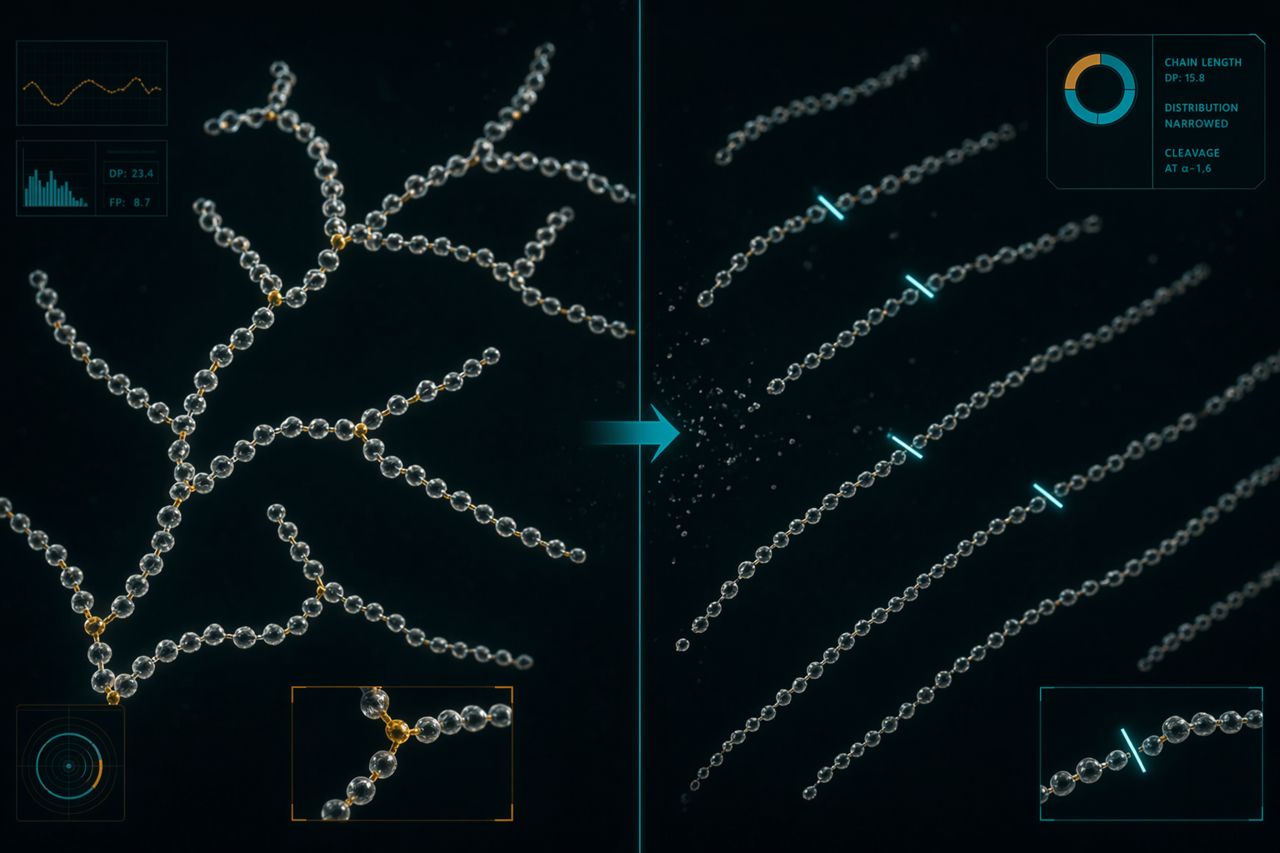
Pullulanase, properly named Pullulanase (Pullulan 6-alpha-glucanohydrolase), debranches pullulan, amylopectin, and branched dextrins by cleaving alpha-1,6 linkages.
Once branches are removed, the carbohydrate profile becomes more accessible to other enzymes in the system. Linearized chains are easier for glucoamylase, beta-amylase, or other process-specific enzymes to convert into the target sugar profile.
That debranching step can support:
Pullulanase does not replace the full enzyme system. It removes a structural bottleneck that other enzymes cannot fully solve on their own.
In industrial starch conversion, unconverted branches are not academic. They affect yield, throughput, filtration, downstream consistency, and raw material economics.
If alpha-1,6 linkages remain in the system, processors may see:
Pullulanase improves the system by opening those branch structures. In many processes, this enables the main saccharifying enzyme to work more efficiently because the substrate is less constrained.
In glucose and dextrose syrup production, pullulanase is commonly used with glucoamylase after liquefaction. Alpha-amylase reduces starch into shorter dextrins, but branching remains. Pullulanase removes alpha-1,6 branch points so glucoamylase can release glucose more completely from the resulting linear chains.
Typical performance goals include:
The benefit depends on substrate, dry solids, process hold time, pH profile, temperature profile, and the rest of the enzyme package. Pullulanase selection should therefore be based on application fit, not just label description.
In brewing and distilling, pullulanase helps convert branched dextrins into fermentable carbohydrate pathways. It can be used where higher attenuation, lower residual dextrin, or more complete extract conversion is required.
Relevant use cases include:

For distillers and ethanol producers, the commercial driver is straightforward: more usable carbohydrate from the same grain bill supports better fermenter economics. For brewers, the value may be attenuation control, dryness, and carbohydrate profile management.
Pullulanase is not just another amylase. Its value comes from bond specificity.
| Enzyme | Primary role in starch conversion | Main limitation |
|---|---|---|
| Alpha-amylase | Randomly cuts internal alpha-1,4 linkages to liquefy starch | Does not fully remove branch structures |
| Glucoamylase | Releases glucose from non-reducing chain ends | Slowed by alpha-1,6 branch architecture |
| Beta-amylase | Releases maltose from chain ends | Stops near branch points |
| Pullulanase | Cleaves alpha-1,6 linkages at branch points | Works best as part of a designed enzyme system |
The best process designs use pullulanase where branch removal improves the performance of the overall conversion sequence.
When evaluating pullulanase for production use, buyers should ask for more than a product name. The right commercial enzyme must fit the process and documentation requirements.
Important questions include:
Pullulanase is a precision enzyme. Its purchasing value depends on whether it improves the operating metrics that matter in your plant.
A practical trial should compare the current process against a pullulanase-assisted process under controlled plant or pilot conditions.
Useful indicators include:
Avoid judging pullulanase only by input cost. The business case is usually built from improved yield, process time, conversion completeness, and consistency.
If pullulanase is added after the substrate profile is already poorly suited for debranching, the benefit may be limited. Placement in the process matters.
Pullulanase opens branches. Glucoamylase releases glucose from chain ends. They are complementary, not interchangeable.
Debranching performance depends on the actual plant environment. Compatibility with temperature, pH, solids, calcium exposure, residence time, and other enzymes should be confirmed.
A pullulanase trial should look at sugar profile, residual dextrin, fermentation performance, and downstream handling. A single metric can miss the commercial value.
Alpha-1,6 linkages are small structural features with large process consequences. They create branches that limit complete starch conversion. Pullulanase removes those branches, making starch-derived carbohydrates more accessible and improving the performance of the enzyme system around it.
For starch processors, brewers, distillers, and formulation teams, the question is not whether pullulanase cuts alpha-1,6 linkages. The question is how much value debranching can unlock in your specific process.
Use the form below to request a quote, compare formats, or discuss whether pullulanase fits your starch, brewing, distilling, or formulation process.
Tell us your application and volume — we reply with pricing and lead time.